Comprehensive financial analysis examining sales performance across 10 countries, multiple product segments, and customer categories using advanced statistical methods.
Total Sales Revenue
Units Sold
Government Market Share
Top Country Sales (Namibia)
To analyze comprehensive sales data spanning 2013-2014 across multiple countries and customer segments, identifying key trends, performance patterns, and opportunities for strategic decision-making in market expansion and resource allocation.
Employed descriptive statistics, data visualization, and comparative analysis techniques. Cleaned and standardized data from multiple sources, performed segmentation analysis, and created interactive dashboards for stakeholder insights.
Government sector dominates with 44.2% market share ($52.4M in sales), suggesting strong B2G relationships and potential for public sector expansion. However, the cost of goods sold analysis revealed that Paseo, despite highest sales, has elevated operational costs that may impact profitability margins.
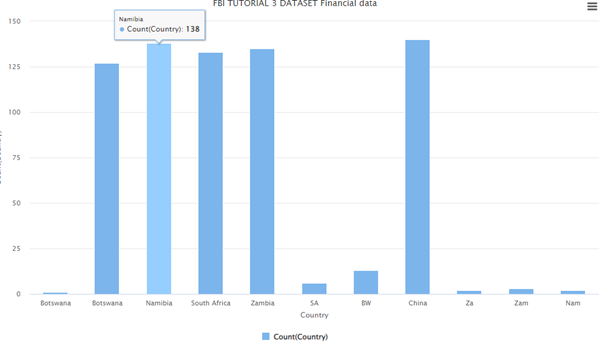
Insight: Namibia leads with 237,442 units sold (21.09% of total), significantly outperforming other markets. However, China shows second-highest COGS at $22M despite fewer units sold, indicating higher operational costs. This geographical analysis revealed a 235,551 unit spread between top (Namibia) and bottom (ZA) performers, highlighting major market disparities that require targeted strategies.
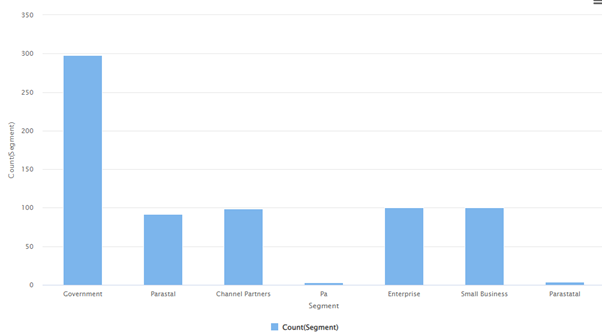
Insight: Government sector generates $52.4M in sales with $56M in gross sales, representing 44.2% market dominance. Parastatals show the lowest performance at $180,236, creating a $52.3M spread. This concentration suggests dependency on government contracts and highlights diversification opportunities in underserved segments like small business and enterprise markets.
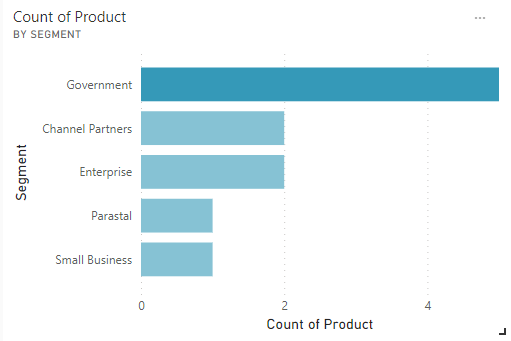
Insight: Paseo dominates with 28.9% market share (202 transactions) and highest sales, but also shows highest COGS at $28.2M, potentially impacting profit margins. Montana, despite lowest frequency (13.3%, 93 transactions), maintains moderate COGS at $13.3M. Amarilla commands premium manufacturing price ($260) while Carretera has lowest at $3, suggesting diverse product positioning strategies across the portfolio.
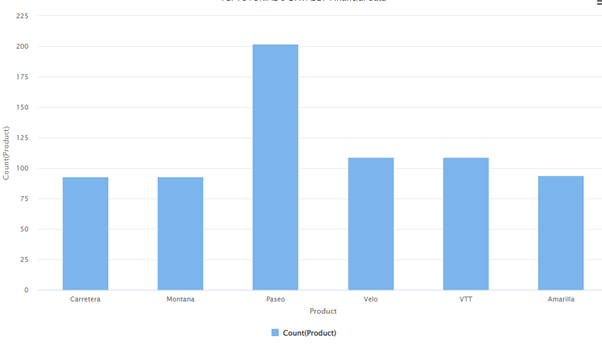
Insight: Distribution chart reveals Paseo's market dominance with the highest frequency count, followed by a more balanced distribution among other products. This visualization helps identify which products are driving volume and which may need additional marketing support or strategic repositioning to capture greater market share.
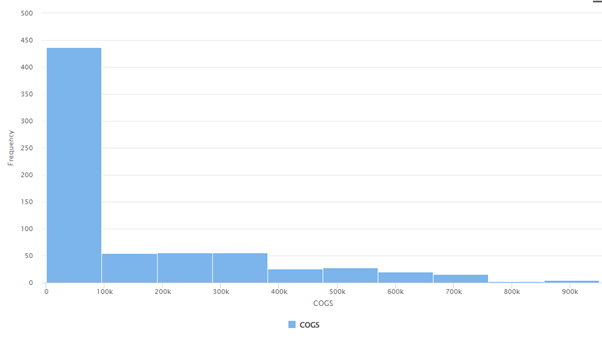
Insight: COGS distribution shows significant variation across the portfolio with a maximum of $950,625 and average of $145,479. The data reveals operational cost patterns that directly impact profitability. Understanding these cost structures enables better pricing strategies and identifies opportunities for cost optimization across product lines.
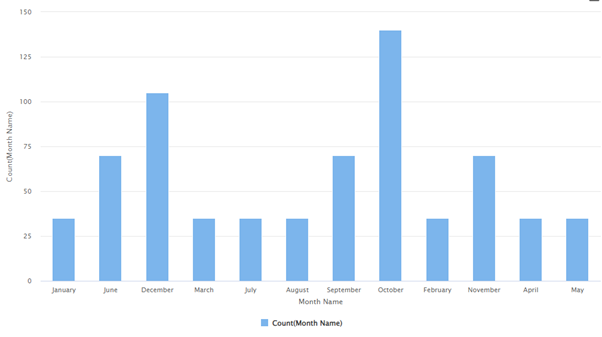
Insight: Analysis of monthly distribution reveals strong seasonality with peaks in months 11-12 (end of year), reaching maximum frequency of 175 transactions in December. Additional spikes observed in months 5.5-6.5 (mid-year) and months 1-2 (beginning of year), suggesting quarterly purchasing cycles. This pattern enables optimized inventory management and targeted marketing campaigns during high-activity periods.
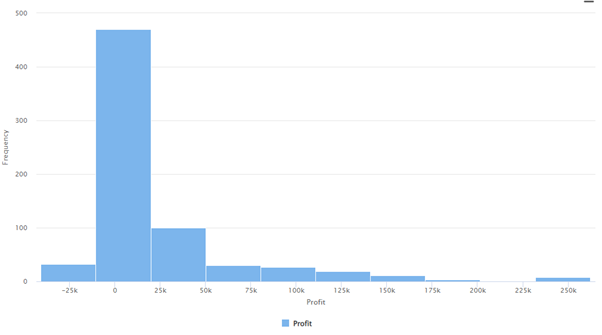
Insight: Profit analysis reveals a range from -$40,618 (losses) to $262,200 (maximum profit) with an average of $24,138. The distribution shows most profitable transactions cluster in the $10,335-$19,946 range. This insight is critical for identifying high-margin opportunities and addressing loss-making transactions to improve overall portfolio profitability.
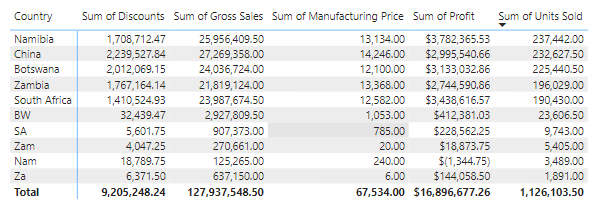
Insight: Comprehensive country-level review comparing units sold, manufacturing costs, COGS, and profitability across all 10 markets. China leads in frequency (20% of dataset) while Botswana shows the lowest presence. This multi-dimensional view enables targeted country-specific strategies for market penetration and resource allocation optimization.
Government sector's 44.2% dominance creates vulnerability. Recommend diversifying into enterprise (currently 2 products) and small business segments (1 product) to reduce dependency and create balanced revenue streams across customer categories.
With Namibia at 21% and bottom performer (ZA) at near-zero, there's significant untapped potential. Focus on replicating Namibia's success model in underperforming markets while addressing China's high COGS issue ($22M) to improve operational efficiency.
Despite Paseo's market leadership (28.9%), its COGS of $28.2M requires cost reduction initiatives. Consider operational efficiency improvements or strategic pricing adjustments to maintain volume while improving margins across high-volume products.
Clear end-of-year peak (175 transactions in December) indicates budget-driven purchasing. Implement targeted Q4 campaigns and ensure inventory availability. Consider incentive programs during slower months (month 8) to smooth demand fluctuations.
Managed 700+ transaction records with standardization of inconsistent formatting, handling of missing values, and removal of duplicates. Implemented statistical methods including mean/median imputation for numerical fields and mode replacement for categorical data. Ensured data integrity through validation checks and outlier detection.
Created interactive dashboards using Power BI with drill-down capabilities across country, segment, and product dimensions. Implemented histograms for distribution analysis, pie charts for market share visualization, and trend lines for temporal patterns. Enabled dynamic filtering for stakeholder-specific views.
Applied descriptive statistics (mean: 169,617.57, median, mode, standard deviation) for central tendency analysis. Conducted comparative analysis across dimensions, calculated percentage distributions, and performed segmentation analysis. Used RapidMiner for advanced pattern recognition and correlation analysis between variables like manufacturing price, sales, and COGS.
Challenge: Encountered duplicates in unit attributes, inconsistent formatting
across countries, and unbalanced data distribution.
Solution: Implemented systematic cleansing process with deduplication algorithms,
standardized naming conventions, and applied uniform formatting across all fields. Created data
quality metrics to track improvements.
Challenge: Data heavily left-skewed with significant disparities between
market leaders and laggards, making meaningful comparisons difficult.
Solution: Applied logarithmic transformations for visualization, created
separate analyses for outliers, and used percentage-based comparisons to normalize insights
across different scales.
Delivered 8+ strategic recommendations across market segments and geographies
Achieved 100% data cleansing with zero missing values in final analysis
Created intuitive dashboards accessible to non-technical decision makers